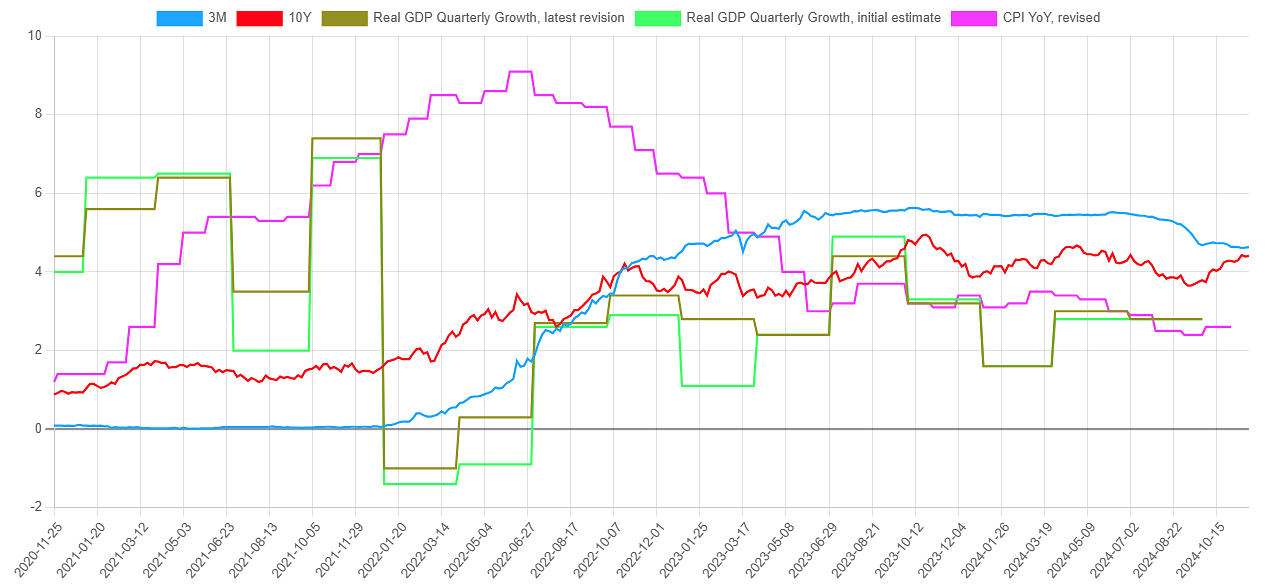
Earlier this year we greatly expanded the functionality of the US Treasuries & Economic Indicators Time Series page, allowing users to compare interest rates against other economic data such as GDP and inflation metrics. It is important to note that such economic data released by the US government is frequently revised. This means that the historical data you are looking at today could be very different from how it was originally reported. On the Time Series page, we provide you the option to view the values as their current official datasets or as the values were reported when the data releases were first made public.
Some metrics get revised more radically than others. GDP is notorious for undergoing numerous revisions that could result in drastic differences from the initial report over time. This is why recessions are often only realized by the government reporting agencies well after the fact. For example, in the figure above, real GDP growth for the Fourth Quarter of 2021 was 6.9% in the "Advance" estimate of the Bureau of Economic Analysis, reported January 27, 2022. On September 26, 2024, a "comprehensive revision" by the BEA changed this value to 7.9%.
Comprehensive revisions occur regularly, in which case the BEA may make changes to the last 5 years of reported GDP figures. Comprehensive revisions can even overwrite what that BEA calls "Final" GDP estimates. The Q4:2021 "Final" estimate, provided in a press release dated March 30, 2022, stated the real GDP growth to be 6.9%.
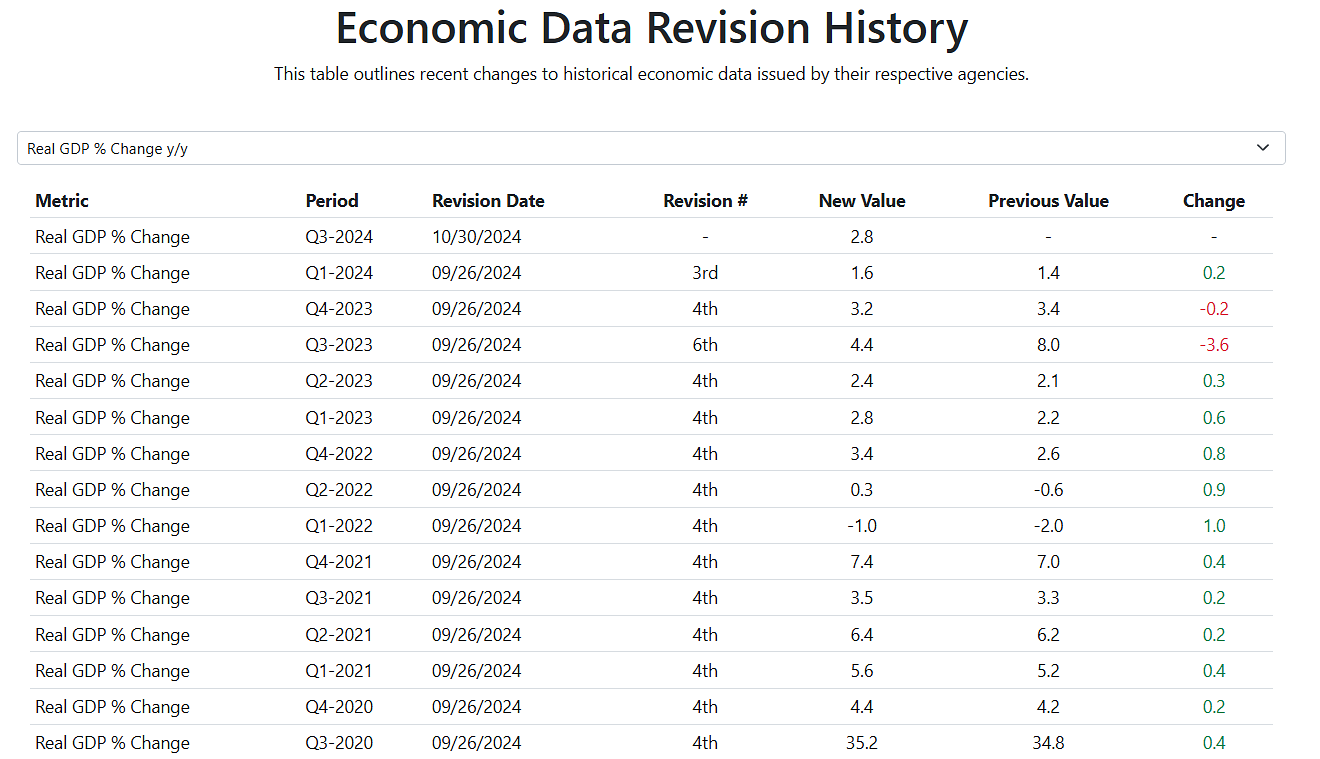
On our new page titled Economic Data Revision History provides a table of economic data revisions, allowing you to see the number of changes to a given data set over time. At the time of its release, you can view the history of revisions to CPI, PPI, real GDP growth, and the unemployment rate. More datasets will be available soon!
Why many GDP revisions are labeled on 6/17/2024
When viewing the GDP economic revisions, a large amount of the data has a "Revision Date" of 6/17/2024. That is the date which this website began aggregating the real GDP growth metrics from BEA data. We felt it appropriate to label those data points with that particular date because we know that's what the figures were reported by the BEA as of that date. We do not have information as to the originally reported values of those data points and their revision history. All we can verify is how the BEA reported them on 6/17/2024.
Most of the other GDP revision dates and originally reported values have been obtained from the BEA press release archive. Unfortunately, this archive only has press releases going back to 1994. We do not have a history of revisions for GDP growth prior to that.
CPI y/y revisions
The "seasonally adjusted" CPI, which is used for month-to-month comparisons, is subject to revision for up to 5 years. The "not seasonally adjusted" CPI figures are revised infrequently, and usually only occur when the Bureau of Labor and Statistics changes calculation methodology. Some significant revisions are noted around these years:
1919: The BLS began publishing separate consumer price indexes for 32 cities. This was the initial attempt to systematically measure changes in consumer prices across different urban areas.
1940: The first major revision of the CPI was implemented, which included a shift to a more comprehensive sample of goods and services and updated weights based on the 1934-36 Consumer Expenditure Survey.
1953: Another significant revision introduced a new base period (1947-49) and expanded the geographic coverage of the index.
1964: The CPI was revised to use the 1960-61 Consumer Expenditure Survey for weights, and the base period was updated to 1957-59.
1978: This revision introduced a new base period (1972-74) and incorporated changes in the sampling and pricing methods. It also marked the beginning of the CPI for All Urban Consumers (CPI-U) and the CPI for Urban Wage Earners and Clerical Workers (CPI-W).
1988: The base period was updated to 1982-84, and the methodology was further refined to improve accuracy.
2000: Starting in 1998, BLS began using a geometric mean formula for most basic indexes that mitigates lower level substitution bias and reflects shifts in consumer spending with item categories as relative price change
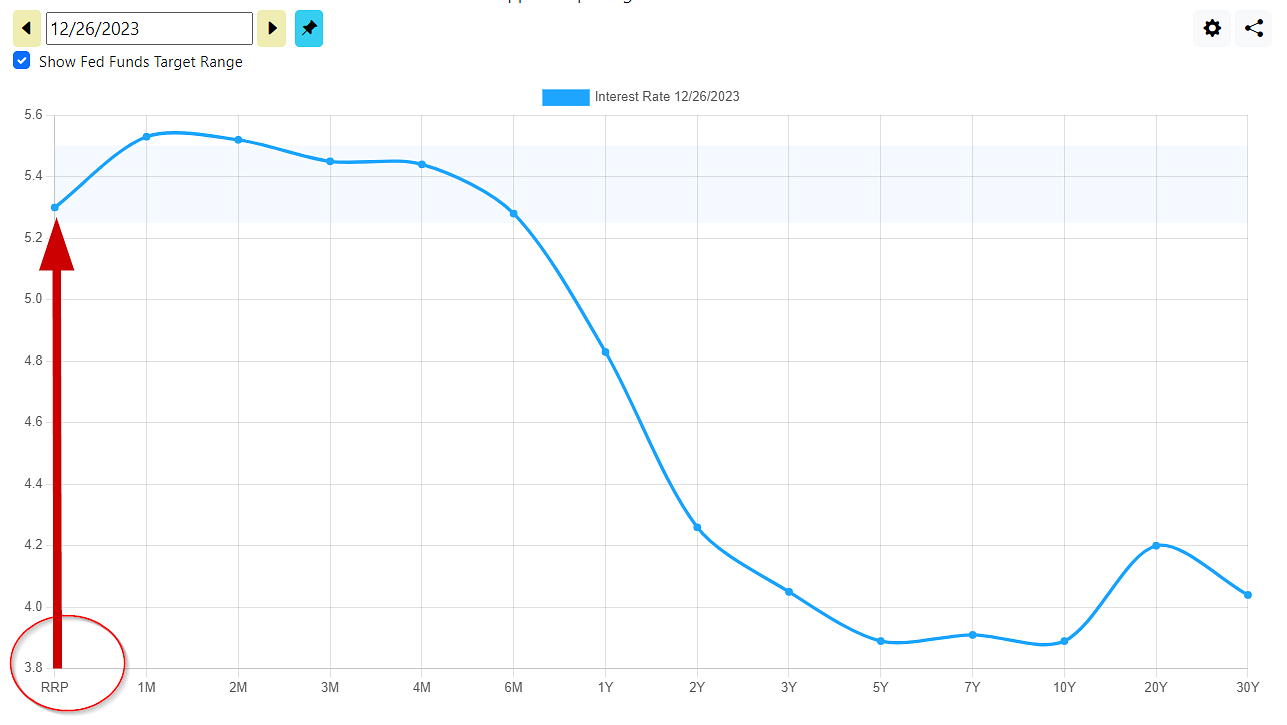
We just added the Fed's Overnight Reverse Repurchase Agreement Award rate to our yield curve and time series charts, denoted as "RRP". In context of the term structure of interest rates, RRP is the shortest of short term yields. It is the overnight interest rate awarded by the Fed in exchange for holding collateral. Banks use this facility as a means to generate return on their excess deposits.
The Reverse Repurchase facility is an instrumental tool used by the Fed for keeping short term interest rates within the FOMC's Fed Funds target range. Because the Fed decides the interest rate on the Reverse Repurchase facility, it sets a floor on interests. Without this facility, interest rates could potentially drift below the Fed Funds target range.
The Reverse Repurchase facility is only available to member banks, which includes commercial banks, investment banks, credit unions, and money market funds. It is not available to individuals. In theory, some of the money earned by the banks on their deposits would pass through to the bank's customers in the form of interest, with the bank keeping a spread as profit. However, many of the larger financial institutions lately have been keeping the reverse repo earnings for the firm, and paying depositors a very low interest or nonexistent rate. Investment into money market funds are probably the best way for individuals to capitalize on this Fed tool, albeit indirectly.
The Reverse Repo Facility Balance is Declining
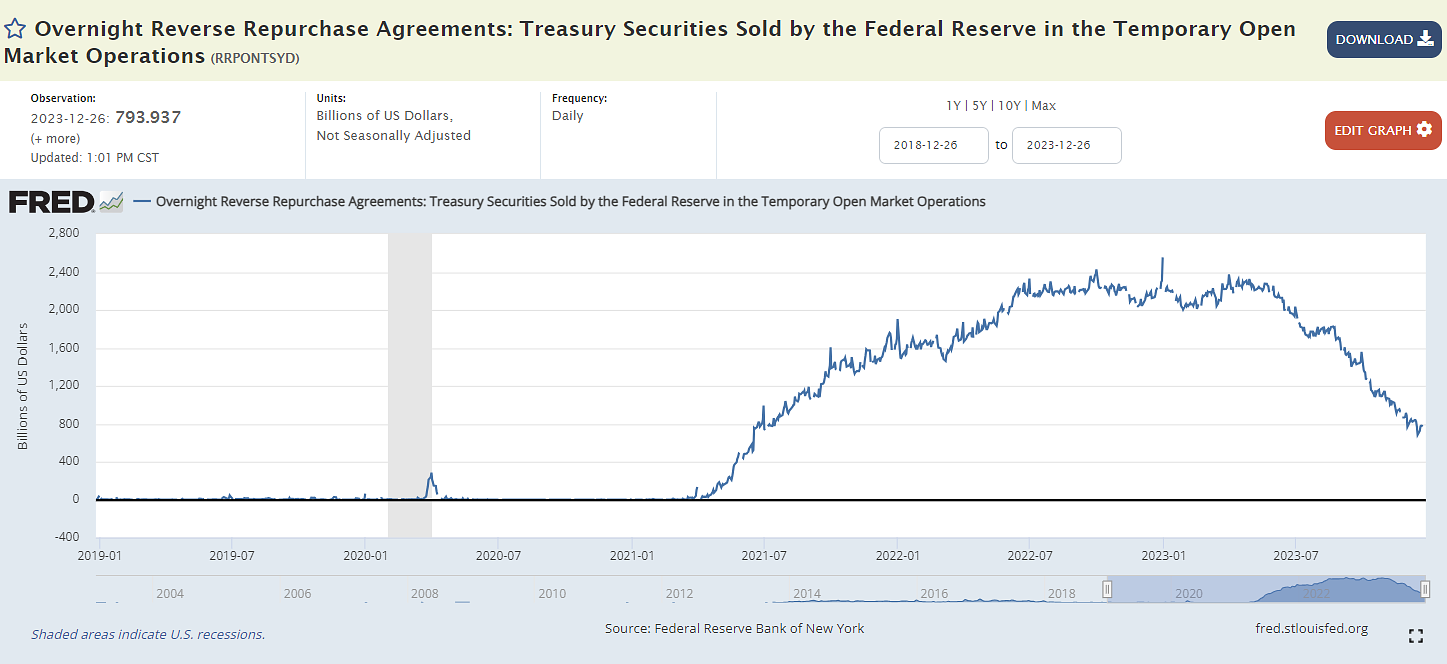
Lately some experts who closely follow the Fed have noted that the utilization of Reverse Repo facility has been declining in recent months. The Treasury Department's fiscal stimulus efforts in 2020 and 2021 led to many individual homes being sent checks directly, which ended up as deposits in the banking system. A good share of this influx of deposits made its way into the reverse repo facility as banks needed a place to put the excess cash on their balance sheet to work.
At it's peak in 2023, the facility had nearly $2.5 trillion. As it's usage declines some believe this is a sign of drying up excess liquidity in the banking system. This could occur for a variety of reasons. Banks may be finding more attractive short term investments for their excess deposits. The customer deposits may be shrinking, causing money to flow out of the banking system into other places. That could be inflationary if not coupled with a decrease of the money supply. If banks are putting their excess deposits to work in longer duration investments, there is an increased potential for stress within the banking system if a large amounts of deposits are unexpectedly withdrawn.
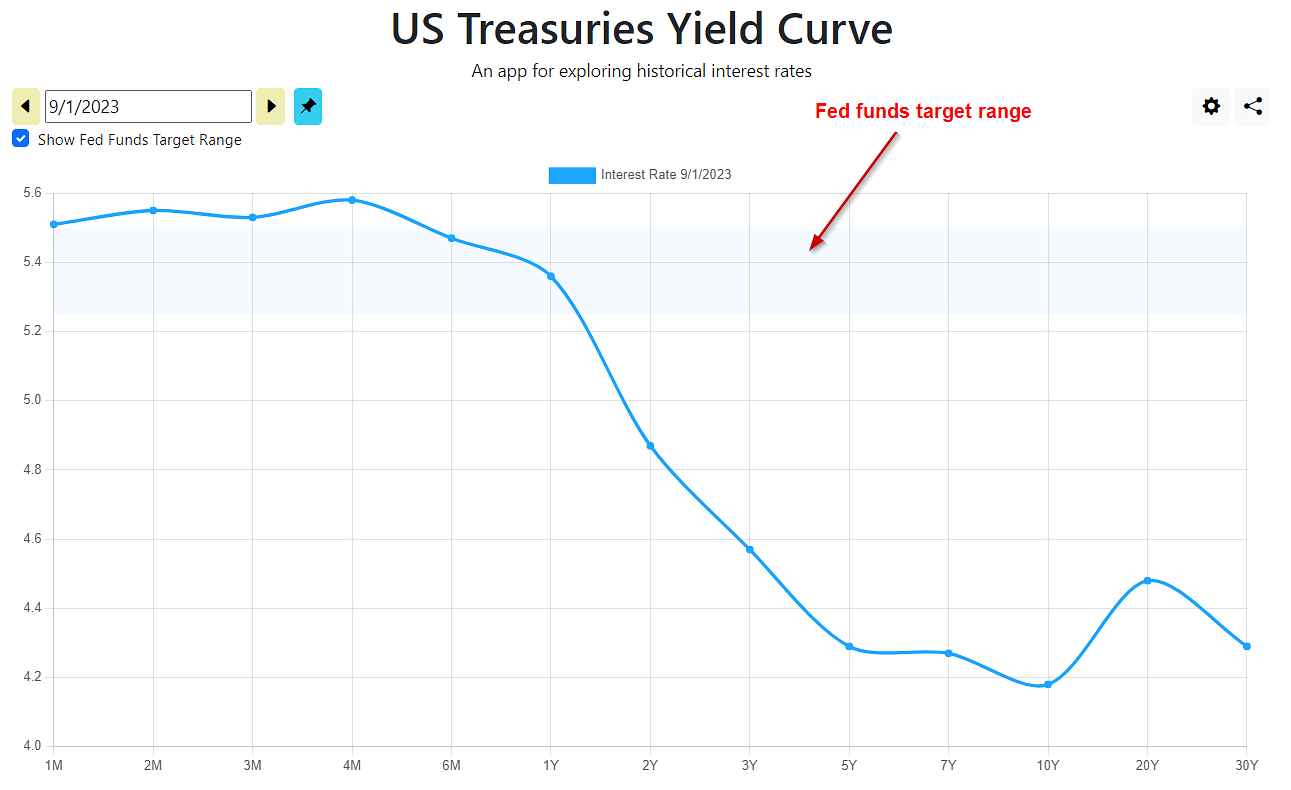
This Labor Day weekend we launched a significant update to ustreasuryyieldcurve.com, adding the Federal Funds Target Rate to the US yield curve chart. The FOMC expresses its target of the short term overnight lending rate for banks as a range, currently at 5.25-5.5%. This is the interest rate widely cited in the media whenever the Fed raises or lowers interest rates.
The data is available back to 1982. Prior to October 1982, the Fed targeted M2 money supply growth instead of setting a specific interest rate. The M2 control policy was specifically designed to combat high inflation during the early 1980s recession, and ran from October 1979 to October 1982 under the leadership of Paul Volker. Prior to that, the Fed did control interest rates through open market operations, but did not publicize its interest rate targets as it does today.
This update also introduces a change to the navigation on the yield curve page. When clicking the "Pin current dataset" button, the cursor changes so that the newly added dataset becomes the active yield curve when you change the date. This makes it easier to order the dates chronologically.